Desert Botanical Garden- Arizona
It is a very famous Cactus Garden wherein one can find hundreds of varieties of cactuses grown, maintained and decorated very nicely. The Garden is very big in size and requires sufficient time and energy to visit it, as you have to walk a long distance on different trails to enjoy various species displayed there.

You can find number of parts specifically displaying particular varieties of cactus and allied shrubs or trees. You can find number of volunteers standing there and guiding you while you move in different areas of the garden.

Most people think they know a cactus when they see one, but they are often mistaken. All cacti are succulents, but not all succulents are cacti. Agaves, ocotillos, aloes, and the succulent euphorbias (such as African milk trees) are among the swollen or spiny plants often mistaken for cacti. However, the term cactus refers to a particular family of plants defined by a distinctive flower pattern. To be a cactus, the plant must produce flowers with the following characteristics: many tepals (combined sepals and petals) that intergrade with each other; many stamens (usually hundreds), and numerous stigma lobes (rarely only three). If a plant lacks such a flower, it cannot be a cactus.
The majority of cactus species are pollinated by numerous species of bees, a number of which specialize in cacti. Cactus bees are all solitary, but in some species the females congregate by hundreds of thousands at nesting sites to dig their individual nest burrows, which are densely concentrated in an area of a few thousand square feet. Cactus pollen is packed into these burrows to feed the grubs, which the parents do not tend. Some cacti are pollinated by birds, moths, or bats.
following were some of the species prominently found in above garden -
Organ Pipe Cactus-

The many, usually unbranched stems that arise from ground level readily distinguish an organ pipe cactus from a saguaro. The stems also are thinner, and have solid woody cores. Plants are usually 9 to 11 feet (2.7-3.4 m) in height, but occasionally exceed 20 feet (6.1 m). The pinkish-white flowers, produced from April through August, open after dark and close shortly after sunrise. The spines on the fruit loosen and fall at ripeness. The juicy, sweet, red pulp contains many tiny seeds
Senita
generally grows 10 to 13 feet (3 to 4 m) tall and has the same general form as organ pipe cactus. It differs in having stems with only 5 to 7 (rarely up to 10) ribs and very short spines on the juvenile stems, giving them a sharply angular aspect. Mature (flower-producing) stems are quite different; they're densely covered with long, bristly, gray spines. Pink, nocturnal flowers about an inch (2.5 cm) in diameter emerge through the bristles from April through August; they emit an unpleasant odor. They are followed by marble-sized red fruits with juicy red pulp.

Engelmann Prickly Pear -

Engelmann prickly pear is a shrubby cactus forming hemispherical mounds up to 5 feet (1.5 m) high and 2 or 3 times as wide. Pad size varies with individual plants; the largest are over a foot (30 cm) long. (these giants may be hybrids with other species.) The spines are also variable.
The juicy, palatable fruits ripen in tremendous numbers in July and August. Most saguaro fruits, produced in similar abundance earlier in the summer, are devoured the same day they ripen. But Engelmann prickly pear fruits persist for several months. Though they are eaten by a wide variety of animals including rabbits, packrats, javelina, deer, squirrels, numerous birds, desert tortoises, and cactus beetle
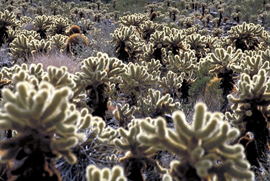
Teddy bear cholla

This distinctive cholla has a vertical trunk 3 to 5 feet (1-1.5 m) tall with densely-packed horizontal side branches on the upper foot (30 cm) or so. Older, lower side branches die and fall off. The joints are very densely spined; very little of the living surface can be seen through its armor. The spines are especially sharp and strongly-barbed. Young spines are yellow and become black with age. Yellow-green flowers in spring are followed by spineless fruits that usually contain no fertile seed
wild animals -
In one section in the park we can find number of wild animals. We could see 3-4 different Owels of different colors and sizes, They were easily handled by the men and women , who had their hands fully covered by thick hand gloves full size.
Similarly we could see various types of snakes, wild frogs and other animals too.
Saturn and Moon views -
This is one important segment of the part, isolated from others. you can inside with batteries provided out freely. You cannot use your mobile inside as per rules. It is complete darkness over a pretty long peace of land, wherein two big size telescopes manned by two different people.
You have to stand in a row of visitors who wish to see it. Then one by one you move forward and see through the tescope first - Saturn. I could find it clearly visible. It is pretty sparking, shining with colorful rings around it. It is at a far distance from earth, but the machiney can help you find like very near. Though the image is very small, you can see it completely
Thereafter we move forward to see the Moon from the another telescope. The image of moon is comparatively big - we can see its size, radius, shape - further the number of holes, lines, lairs of land, etc on the moon. It is clearly visible. It is very interesting to see both these planets.
We were walking for about one and half hour and still all sections of the garden we could not visit or see. So it required 3-4 hours minimum, even if you just want to take a round and have a look at some of them.

No comments:
Post a Comment